Konbini · コンビニ · Japan’s convenience stores
In 2008, Japan’s biggest konbini chain had 12,000 stores — and none in 13 prefectures
7-Eleven opened its first store in Japan in May 1974 and reached its 47th prefecture, Okinawa, in July 2019. Each tile below is one prefecture, lit in the month 7-Eleven arrived; later, its dots are stores by chain.
Sources: the chains’ own store lists and histories, starting with セブン‐イレブン「データで見るセブン‐イレブン」都道府県別出店時期, and the national counts of the Japan Franchise Association and METI.
By 2008, 7-Eleven had 12,034 stores. Want to guess where it still had none?

Lit tile: 7-Eleven has a store in the prefecture
May 1974: 7-Eleven opens its first store in Japan, in Tokyo (豊洲店, Toyosu). At the end of its first fiscal year, February 1975, it had 15 stores. Each tile is one of the 47 prefectures; a tile lights in the month 7-Eleven’s own list gives for its first store there.
Sources: セブン‐イレブン・ジャパン「沿革」; セブン‐イレブン「データで見るセブン‐イレブン」都道府県別出店時期; セブン‐イレブン・ジャパン「売上高、店舗数推移」
1968 to 1974 · the claims to be Japan’s first konbini, each as its source states it
Japan’s first konbini
Six stores opened between 1968 and 1974 have been called Japan’s first konbini. Which came first depends on what counts as a konbini, so each card gives the claim as its source states it, how strong the claim is and the source, and none is named the winner. Strength records whose claim it is (the company’s own or a third party’s) and whether it is qualified.
1968
サンマート (丸正) Sun Mart
Sun Mart, Kobe area. Claimed as: convenience-format store (voluntary chain).
- The claim, as stated
- Kawabe 2004 names 丸正’s サンマート as the first of the wholesaler-led voluntary-chain convenience stores
- Strength
- weak: secondary, definitional (VC member shop converted)
- Source (a third party)
- 川辺信雄「コンビニエンス・ストアの経営史―日本におけるコンビニエンス・ストアの30年―」『早稲田商学』400号 (2004)
1969
マイショップ My Shop
My Shop, マミー豊中店, Toyonaka, Osaka. Claimed as: convenience store (commonly cited).
- The claim, as stated
- Kawabe 2004 opens ‘the 30 years of Japanese convenience stores’ with this store (Wikipedia gives 1969-03-17, lead only)
- Strength
- moderate: academic secondary; no company primary (chain dissolved 1986)
- Source (a third party)
- 川辺信雄「コンビニエンス・ストアの経営史―日本におけるコンビニエンス・ストアの30年―」『早稲田商学』400号 (2004)
11 July 1971
ココストア Coco Store
Coco Store, 藤山台店, Kasugai, Aichi. Claimed as: convenience store (self-proclaimed birthplace).
- The claim, as stated
- Monument: 日本のコンビニエンスストア発祥の地; Coco Store called itself Japan’s first convenience store
- Strength
- weak: self-claim reported by local media; Kawabe confirms only the year
August 1971
セイコーマート Seicomart
Seicomart, Sapporo. Claimed as: oldest convenience chain still operating (candidate).
- The claim, as stated
- Secoma: 日本で現存する最も古いコンビニエンスストアのひとつ (one of the oldest existing)
- Strength
- moderate: company claim, hedged as ‘one of’
- Source (the company’s own)
- セコマ「セコマグループのあゆみ」
September 1973
ファミリーマート FamilyMart
FamilyMart, Sayama, Saitama. Claimed as: FamilyMart as Japan-born CVS.
- The claim, as stated
- FamilyMart: 日本発祥のコンビニエンスストア (trial store by Seiyu)
- Strength
- moderate: company claim about its own origin
- Source (the company’s own)
- ファミリーマート「沿革」
May 1974
セブン‐イレブン 7-Eleven
7-Eleven, 豊洲店, Koto-ku, Tokyo. Claimed as: full franchise-system convenience store.
- The claim, as stated
- SEJ: 日本初の本格的なフランチャイズシステムによるコンビニエンスストア
- Strength
- strong for the qualified claim (franchise system); not the first convenience store
- Source (the company’s own)
- セブン‐イレブン・ジャパン「セブン‐イレブンの歴史」; セブン‐イレブン・ジャパン「沿革」
Lit tile: 7-Eleven has a store in the prefecture
The chains’ own pages give no store counts by prefecture before 2003, so this act shows only where 7-Eleven was. A dark tile means no 7-Eleven yet; other chains may be there.
Sources: セブン‐イレブン「データで見るセブン‐イレブン」都道府県別出店時期
1974 to 1996: each prefecture lights in its entry month, and the counter gives 7-Eleven’s stores at each fiscal year end. By the end of 1996 it was in 25 prefectures, and at its fiscal year end in February 1996 it had 6,373 stores. Dark still means no 7-Eleven, not no konbini.
Sources: セブン‐イレブン「データで見るセブン‐イレブン」都道府県別出店時期; セブン‐イレブン・ジャパン「売上高、店舗数推移」
July 1997: Lawson opens 20 stores at once in Okinawa and, by its own history, has stores in all 47 prefectures. The blue strip along every tile’s foot is Lawson. 7-Eleven was in 25.
Sources: ローソン「沿革」(2004 capture); セブン‐イレブン「データで見るセブン‐イレブン」都道府県別出店時期
At their fiscal year ends in February 2008, 7-Eleven, Japan’s biggest konbini chain, had 12,034 stores and Lawson, second, had 8,587. At the end of 2008, 7-Eleven had none in 13 prefectures (outlined): Aomori, Akita, Toyama, Ishikawa, Fukui, Tottori, Shimane, Tokushima, Kagawa, Ehime, Kōchi, Kagoshima and Okinawa. FamilyMart had reached all 47 in July 2006.
Sources: セブン‐イレブン・ジャパン「売上高、店舗数推移」; ローソン Annual Report 2016 (domestic stores at each fiscal year end, FY2006–2015); セブン‐イレブン「データで見るセブン‐イレブン」都道府県別出店時期; ファミリーマート 第26期中間報告書
2009 to 2019: the last 13 light, from Toyama and Fukui in January 2009. Shikoku had no 7-Eleven until March 2013. Okinawa, across the sea from Kyūshū, comes last, in July 2019.
Sources: セブン‐イレブン「データで見るセブン‐イレブン」都道府県別出店時期


One konbini rice ball in its three-tab wrapper, built as the wrapper patents describe it
Why the nori is still crisp
Until you open it, a film sits between the nori and the rice. Pull ① and the tape runs down the front, under the base and up the back, cutting the outer film in two. Pull ② and ③ out sideways: each half takes the inner film sealed to it, sliding off both sides of the nori, and the nori is left on the rice. Drag to turn it; See-through spreads the layers apart.

- おにぎりrice ball
- 海苔のりnori (seaweed)
- ご飯ごはんrice
- 具ぐfilling
- フィルムfilm
- 外フィルムそとフィルムouter film
- 内フィルムうちフィルムinner film
- カットテープcut tape (tear strip)
- ラベルlabel
Lit tile: 7-Eleven has a store in the prefecture
So far a lit tile has meant only that 7-Eleven was there. The story now goes back to 2006, the first year with store counts by prefecture for 7-Eleven, FamilyMart, Lawson, Circle K Sunkus and Ministop. Seicomart’s begin in 2009, Poplar’s in 2016. From here one dot is 20 stores of one chain, computed and rounded within each prefecture.
Sources: 7-Eleven store counts by prefecture, July 2006; FamilyMart store counts by prefecture, January 2006; Lawson store counts by prefecture, February 2006; Circle K Sunkus store counts by prefecture, March 2006; Ministop store counts by prefecture, April 2006

February 2006: the dots stock in, coloured by chain, each prefecture’s leader among the covered chains first and on the band along its top. Computed leaders: 7-Eleven in 22, Lawson in 12, Circle K Sunkus in 8, FamilyMart in 4. Hokkaidō has no band: Seicomart is not covered before 2009, so no leader can be named there. The covered chains had 34,446 stores across the pages’ dates; JFA counted 40,616 konbini in Japan at the end of 2006. Daily Yamazaki, NewDays and other chains publish no counts by prefecture.
Sources: 7-Eleven store counts by prefecture, July 2006; FamilyMart store counts by prefecture, January 2006; Lawson store counts by prefecture, February 2006; Circle K Sunkus store counts by prefecture, March 2006; Ministop store counts by prefecture, April 2006; 日本フランチャイズチェーン協会「コンビニエンスストア統計時系列データ(2005年~2016年)」
February 2011. Computed leaders: 7-Eleven in 22, Lawson in 14, Circle K Sunkus in 7, FamilyMart in 3, Seicomart in 1. No 7-Eleven counts by prefecture survive between January 2007 and December 2010, so the map steps from 2006 to 2011.
Sources: 7-Eleven store counts by prefecture, February 2011; FamilyMart store counts by prefecture, May 2011; Lawson store counts by prefecture, February 2011; Circle K Sunkus store counts by prefecture, March 2011; Seicomart store counts by prefecture, February 2011; Ministop store counts by prefecture, February 2011
February 2016, before the merger. Computed leaders: 7-Eleven in 23, Lawson in 14, Circle K Sunkus in 4, FamilyMart in 3, Seicomart in 1. Exact ties leave Fukui and Nara without a band: FamilyMart and Lawson with 106 each in Fukui and 7-Eleven and Lawson with 128 each in Nara. Seicomart’s figures here come from a March 2016 page whose lines match its May 2017 page exactly.
Sources: 7-Eleven store counts by prefecture, February 2016; FamilyMart store counts by prefecture, January 2016; Lawson store counts by prefecture, February 2016; Circle K Sunkus store counts by prefecture, February 2016; Seicomart store counts by prefecture, March 2016; Ministop store counts by prefecture, February 2016; Poplar store counts by prefecture, February 2016
September 2016 to November 2018: Circle K Sunkus stores become FamilyMarts. FamilyMart’s own monthly count of stores still under the Circle K and Sunkus signs falls from 6,004 to 0; 4,545 were converted to FamilyMart. In each prefecture red dots turn FamilyMart green or go dark; the split by prefecture is computed.
Sources: ファミリーマート「月次営業報告の推移」; Each chain’s store counts by prefecture, February 2016 and February 2019 (each page linked in the data tables)
February 2026: Circle K Sunkus is gone. Computed from the stores, the leader changed in 14 of the 47 prefectures between 2011 and 2026 (outlined); 7 of them were Circle K Sunkus leads, gone with the brand. Circle K Sunkus to Lawson: Aomori, Toyama and Kōchi. Lawson to FamilyMart: Iwate, Fukui, Ōsaka and Nara. Circle K Sunkus to FamilyMart: Ishikawa, Gifu, Aichi and Mie. Lawson to 7-Eleven: Kyōto and Hyōgo. FamilyMart to 7-Eleven: Nagasaki. Aichi had 1,038 Circle K Sunkus stores in 2011; FamilyMart has 1,617 there now. The new leader is ahead by under 20 stores in Iwate (7), Hyōgo (4) and Nara (10).
Ōsaka, February 2026: its own dots sort into one bar per chain. FamilyMart 1,359, 7-Eleven 1,310, Lawson 1,200, Ministop 81, Poplar 13. Lawson’s first store opened here, in June 1975; it is third now, behind FamilyMart and 7-Eleven.
Sources: 7-Eleven store counts by prefecture, February 2026; FamilyMart store counts by prefecture, February 2026; Lawson store counts by prefecture, February 2026; Seicomart store counts by prefecture, April 2026; Ministop store counts by prefecture, February 2026; Poplar store counts by prefecture, February 2026; ローソン「沿革」(2004 capture)
Back to the whole map, February 2026. Computed leaders: 7-Eleven in 25, Lawson in 11, FamilyMart in 10, Seicomart in 1. The covered chains had 56,305 stores across the pages’ dates; JFA counted 56,054 at the end of 2025 and METI 56,659.
Sources: 7-Eleven store counts by prefecture, February 2026; FamilyMart store counts by prefecture, February 2026; Lawson store counts by prefecture, February 2026; Seicomart store counts by prefecture, April 2026; Ministop store counts by prefecture, February 2026; Poplar store counts by prefecture, February 2026; 日本フランチャイズチェーン協会「コンビニエンスストア統計時系列データ(2017年~2025年)」; 経済産業省 商業動態統計 確報 2025年12月分 第4部 第4表 (stores by prefecture, 2023–2025)


1 dot = 20 stores of one chain (computed)
The dots stay at February 2026 and fade back. Each tile’s glow and number now show its stores per 10,000 people, computed from METI’s year-end store counts by prefecture and the national population estimates.
Sources: 経済産業省 商業動態統計 2017年報 第IV部 第3表 (stores by prefecture, 2015–2017); 総務省 人口推計 長期時系列 第5表 (2000–2020); 経済産業省 商業動態統計 確報 2025年12月分 第4部 第4表 (stores by prefecture, 2023–2025); 総務省 人口推計 2025年10月1日 第2表
2017: Hokkaidō is densest, 5.59 stores per 10,000 people, computed; Nara is thinnest, 3.46.
Sources: 経済産業省 商業動態統計 2017年報 第IV部 第3表 (stores by prefecture, 2015–2017); 総務省 人口推計 長期時系列 第5表 (2000–2020)
2025: Hokkaidō is still densest, 6.14 stores per 10,000 people, computed. Thinnest: Nara 3.54, Hyōgo 3.68 and Shiga 3.80.
Sources: 経済産業省 商業動態統計 確報 2025年12月分 第4部 第4表 (stores by prefecture, 2023–2025); 総務省 人口推計 2025年10月1日 第2表
Across Japan the count has barely moved since 2017: JFA’s monthly survey counted 55,322 stores at the end of 2017 and 56,054 at the end of 2025.
2014, 3 a.m.: METI’s 2014 census of commerce could classify 35,096 konbini, and 30,244 of them, 86.2%, computed, were open all night. The count covers only the stores METI could classify, and METI says 2014 does not connect with its earlier surveys. The map fades between full glow and its 3 a.m. frame, where each tile dims by its share of stores not open all night, computed from METI’s counts by prefecture: Hokkaidō dims most, 65.4% open all night, and Okayama least, 94.2%.
Sources: 経済産業省 平成26年商業統計 業態別統計編 業態第4表 (stores and stores open all night, by prefecture, 2014)


February 2026 · one prefecture: stores by chain, and stores per 10,000 people in 2025 (computed)
Your prefecture’s receipt
Pick a prefecture to print its konbini: each chain’s stores, their subtotal, how many stores there are per 10,000 people, and when each chain opened its first store there, where the chain’s own history says.
No receipt yet: choose a prefecture above and its stores by chain print here.
Show the data
Every number in the story
Act by act, with the page each number comes from. Download every value as CSV ↓
Every number as tables
| Prefecture | 7-Eleven’s first store | No 7-Eleven at the end of 2008 | Lawson’s first store (its own history) |
|---|---|---|---|
| 北海道 Hokkaidō | May 1978 | October 1978 | |
| 青森県 Aomori | June 2015 | none | not dated |
| 岩手県 Iwate | October 2000 | not dated | |
| 宮城県 Miyagi | May 1982 | October 1978 | |
| 秋田県 Akita | May 2012 | none | not dated |
| 山形県 Yamagata | July 1999 | not dated | |
| 福島県 Fukushima | September 1974 | not dated | |
| 茨城県 Ibaraki | August 1979 | not dated | |
| 栃木県 Tochigi | February 1979 | not dated | |
| 群馬県 Gunma | December 1981 | not dated | |
| 埼玉県 Saitama | October 1974 | August 1976 | |
| 千葉県 Chiba | October 1975 | not dated | |
| 東京都 Tokyo | May 1974 | November 1976 | |
| 神奈川県 Kanagawa | June 1974 | not dated | |
| 新潟県 Niigata | May 1986 | not dated | |
| 富山県 Toyama | January 2009 | none | not dated |
| 石川県 Ishikawa | December 2009 | none | 1986 |
| 福井県 Fukui | January 2009 | none | not dated |
| 山梨県 Yamanashi | April 1983 | not dated | |
| 長野県 Nagano | April 1975 | not dated | |
| 岐阜県 Gifu | November 2005 | not dated | |
| 静岡県 Shizuoka | May 1979 | not dated | |
| 愛知県 Aichi | July 2002 | July 1978 | |
| 三重県 Mie | February 2006 | not dated | |
| 滋賀県 Shiga | March 1991 | not dated | |
| 京都府 Kyōto | March 1991 | not dated | |
| 大阪府 Ōsaka | March 1991 | June 1975 | |
| 兵庫県 Hyōgo | November 1995 | not dated | |
| 奈良県 Nara | July 2001 | not dated | |
| 和歌山県 Wakayama | July 2001 | not dated | |
| 鳥取県 Tottori | October 2015 | none | not dated |
| 島根県 Shimane | February 2009 | none | not dated |
| 岡山県 Okayama | April 1993 | not dated | |
| 広島県 Hiroshima | August 1982 | 1981 | |
| 山口県 Yamaguchi | September 1983 | not dated | |
| 徳島県 Tokushima | March 2013 | none | not dated |
| 香川県 Kagawa | March 2013 | none | not dated |
| 愛媛県 Ehime | March 2014 | none | August 1985 |
| 高知県 Kōchi | March 2015 | none | not dated |
| 福岡県 Fukuoka | April 1979 | September 1978 | |
| 佐賀県 Saga | October 1982 | not dated | |
| 長崎県 Nagasaki | March 2000 | not dated | |
| 熊本県 Kumamoto | June 1987 | not dated | |
| 大分県 Ōita | June 2001 | not dated | |
| 宮崎県 Miyazaki | March 1996 | not dated | |
| 鹿児島県 Kagoshima | March 2011 | none | not dated |
| 沖縄県 Okinawa | July 2019 | none | July 1997 |
Lawson’s history dates its first store in 11 prefectures and says it was in all 47 from July 1997. FamilyMart reached its 47th in July 2006. Store counts by prefecture begin in 2003, so Act 1 shows presence only.
Sources: セブン‐イレブン「データで見るセブン‐イレブン」都道府県別出店時期; ローソン「沿革」(2004 capture); ファミリーマート 第26期中間報告書
| Date | Store | Claimed as | The claim, as stated | Strength | Source |
|---|---|---|---|---|---|
| 1968 | サンマート (丸正) Sun Mart, Kobe area | convenience-format store (voluntary chain) | Kawabe 2004 names 丸正’s サンマート as the first of the wholesaler-led voluntary-chain convenience stores | weak: secondary, definitional (VC member shop converted) | 川辺信雄「コンビニエンス・ストアの経営史―日本におけるコンビニエンス・ストアの30年―」『早稲田商学』400号 (2004) |
| 1969 | マイショップ My Shop, マミー豊中店, Toyonaka, Osaka | convenience store (commonly cited) | Kawabe 2004 opens ‘the 30 years of Japanese convenience stores’ with this store (Wikipedia gives 1969-03-17, lead only) | moderate: academic secondary; no company primary (chain dissolved 1986) | 川辺信雄「コンビニエンス・ストアの経営史―日本におけるコンビニエンス・ストアの30年―」『早稲田商学』400号 (2004) |
| 11 July 1971 | ココストア Coco Store, 藤山台店, Kasugai, Aichi | convenience store (self-proclaimed birthplace) | Monument: 日本のコンビニエンスストア発祥の地; Coco Store called itself Japan’s first convenience store | weak: self-claim reported by local media; Kawabe confirms only the year | toppy.net 2015-09-09 (Coco Store and FamilyMart, quoting the Chunichi Shimbun); 川辺信雄「コンビニエンス・ストアの経営史―日本におけるコンビニエンス・ストアの30年―」『早稲田商学』400号 (2004) |
| August 1971 | セイコーマート Seicomart, Sapporo | oldest convenience chain still operating (candidate) | Secoma: 日本で現存する最も古いコンビニエンスストアのひとつ (one of the oldest existing) | moderate: company claim, hedged as ‘one of’ | セコマ「セコマグループのあゆみ」 |
| September 1973 | ファミリーマート FamilyMart, Sayama, Saitama | FamilyMart as Japan-born CVS | FamilyMart: 日本発祥のコンビニエンスストア (trial store by Seiyu) | moderate: company claim about its own origin | ファミリーマート「沿革」 |
| May 1974 | セブン‐イレブン 7-Eleven, 豊洲店, Koto-ku, Tokyo | full franchise-system convenience store | SEJ: 日本初の本格的なフランチャイズシステムによるコンビニエンスストア | strong for the qualified claim (franchise system); not the first convenience store | セブン‐イレブン・ジャパン「セブン‐イレブンの歴史」; セブン‐イレブン・ジャパン「沿革」 |
| Fiscal year end | Stores |
|---|---|
| February 1975 | 15 |
| February 1976 | 69 |
| February 1977 | 199 |
| February 1978 | 375 |
| February 1979 | 591 |
| February 1980 | 801 |
| February 1981 | 1,040 |
| February 1982 | 1,306 |
| February 1983 | 1,643 |
| February 1984 | 2,001 |
| February 1985 | 2,299 |
| February 1986 | 2,651 |
| February 1987 | 2,964 |
| February 1988 | 3,304 |
| February 1989 | 3,653 |
| February 1990 | 3,954 |
| February 1991 | 4,270 |
| February 1992 | 4,629 |
| February 1993 | 5,058 |
| February 1994 | 5,475 |
| February 1995 | 5,905 |
| February 1996 | 6,373 |
| February 1997 | 6,875 |
| February 1998 | 7,314 |
| February 1999 | 7,732 |
| February 2000 | 8,153 |
| February 2001 | 8,602 |
| February 2002 | 9,060 |
| February 2003 | 9,690 |
| February 2004 | 10,303 |
| February 2005 | 10,826 |
| February 2006 | 11,310 |
| February 2007 | 11,735 |
| February 2008 | 12,034 |
| February 2009 | 12,298 |
| February 2010 | 12,753 |
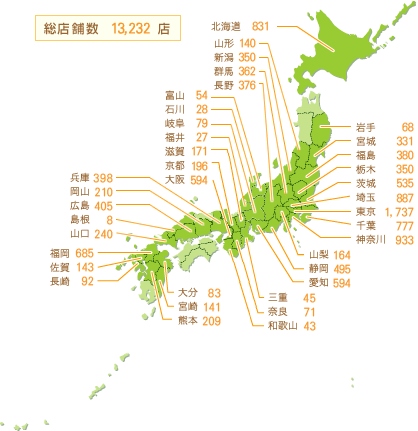
| February 2011 | 13,232 |
| February 2012 | 14,005 |
| February 2013 | 15,072 |
| February 2014 | 16,319 |
| February 2015 | 17,491 |
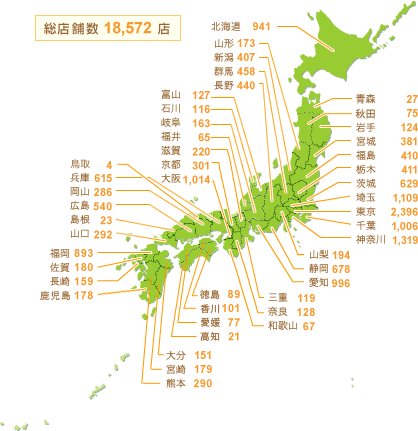
| February 2016 | 18,572 |
| February 2017 | 19,422 |
| February 2018 | 20,260 |
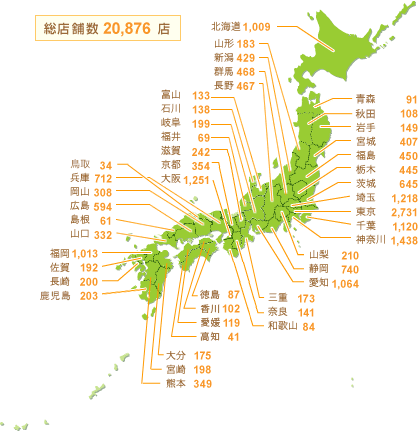
| February 2019 | 20,876 |
| February 2020 | 20,955 |
| February 2021 | 21,167 |
| February 2022 | 21,327 |
| February 2023 | 21,402 |
| February 2024 | 21,533 |
| February 2025 | 21,743 |
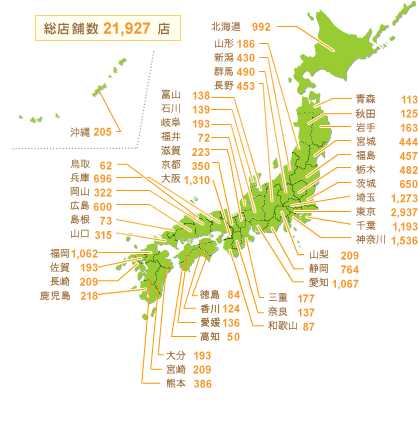
| February 2026 | 21,927 |
Sources: セブン‐イレブン・ジャパン「売上高、店舗数推移」; セブン&アイHD コーポレートアウトライン2026「国内コンビニエンスストア事業」
At its own fiscal year end in February 2008, Lawson, the second-biggest chain, had 8,587 stores.
Sources: ローソン Annual Report 2016 (domestic stores at each fiscal year end, FY2006–2015)
| Prefecture | 7-Eleven | FamilyMart | Lawson | Circle K Sunkus | Seicomart | Ministop | Poplar | Leader (computed) |
|---|---|---|---|---|---|---|---|---|
| 北海道 Hokkaidō | 828 | 0 | 500 | 228 | not covered | 0 | not covered | not determinable (Seicomart not covered) |
| 青森県 Aomori | 0 | 0 | 139 | 175 | not covered | 44 | not covered | Circle K Sunkus |
| 岩手県 Iwate | 7 | 71 | 171 | 93 | not covered | 6 | not covered | Lawson |
| 宮城県 Miyagi | 315 | 184 | 162 | 114 | not covered | 74 | not covered | 7-Eleven |
| 秋田県 Akita | 0 | 2 | 131 | 112 | not covered | 0 | not covered | Lawson (narrow lead, 19 stores) |
| 山形県 Yamagata | 121 | 90 | 55 | 68 | not covered | 0 | not covered | 7-Eleven |
| 福島県 Fukushima | 362 | 139 | 97 | 14 | not covered | 49 | not covered | 7-Eleven |
| 茨城県 Ibaraki | 481 | 127 | 107 | 53 | not covered | 90 | not covered | 7-Eleven |
| 栃木県 Tochigi | 331 | 110 | 105 | 32 | not covered | 21 | not covered | 7-Eleven |
| 群馬県 Gunma | 336 | 85 | 68 | 2 | not covered | 35 | not covered | 7-Eleven |
| 埼玉県 Saitama | 801 | 357 | 323 | 168 | not covered | 159 | not covered | 7-Eleven |
| 千葉県 Chiba | 727 | 249 | 287 | 196 | not covered | 164 | not covered | 7-Eleven |
| 東京都 Tokyo | 1,463 | 1,004 | 843 | 676 | not covered | 288 | not covered | 7-Eleven |
| 神奈川県 Kanagawa | 821 | 499 | 485 | 342 | not covered | 132 | not covered | 7-Eleven |
| 新潟県 Niigata | 319 | 7 | 106 | 71 | not covered | 0 | not covered | 7-Eleven |
| 富山県 Toyama | 0 | 61 | 102 | 149 | not covered | 0 | not covered | Circle K Sunkus |
| 石川県 Ishikawa | 0 | 61 | 73 | 190 | not covered | 0 | not covered | Circle K Sunkus |
| 福井県 Fukui | 0 | 89 | 74 | 59 | not covered | 13 | not covered | FamilyMart (narrow lead, 15 stores) |
| 山梨県 Yamanashi | 150 | 59 | 62 | 0 | not covered | 0 | not covered | 7-Eleven |
| 長野県 Nagano | 338 | 9 | 136 | 115 | not covered | 0 | not covered | 7-Eleven |
| 岐阜県 Gifu | 19 | 86 | 91 | 259 | not covered | 81 | not covered | Circle K Sunkus |
| 静岡県 Shizuoka | 433 | 203 | 151 | 336 | not covered | 106 | not covered | 7-Eleven |
| 愛知県 Aichi | 394 | 425 | 340 | 1,049 | not covered | 191 | not covered | Circle K Sunkus |
| 三重県 Mie | 2 | 113 | 80 | 228 | not covered | 71 | not covered | Circle K Sunkus |
| 滋賀県 Shiga | 142 | 106 | 118 | 55 | not covered | 2 | not covered | 7-Eleven |
| 京都府 Kyōto | 155 | 142 | 181 | 167 | not covered | 27 | not covered | Lawson (narrow lead, 14 stores) |
| 大阪府 Ōsaka | 468 | 619 | 837 | 415 | not covered | 57 | not covered | Lawson |
| 兵庫県 Hyōgo | 338 | 273 | 471 | 191 | not covered | 27 | not covered | Lawson |
| 奈良県 Nara | 56 | 46 | 100 | 111 | not covered | 8 | not covered | Circle K Sunkus (narrow lead, 11 stores) |
| 和歌山県 Wakayama | 37 | 62 | 111 | 16 | not covered | 0 | not covered | Lawson |
| 鳥取県 Tottori | 0 | 12 | 71 | 0 | not covered | 0 | not covered | Lawson |
| 島根県 Shimane | 0 | 9 | 65 | 0 | not covered | 0 | not covered | Lawson |
| 岡山県 Okayama | 177 | 81 | 114 | 140 | not covered | 0 | not covered | 7-Eleven |
| 広島県 Hiroshima | 375 | 129 | 122 | 39 | not covered | 0 | not covered | 7-Eleven |
| 山口県 Yamaguchi | 201 | 9 | 110 | 0 | not covered | 0 | not covered | 7-Eleven |
| 徳島県 Tokushima | 0 | 17 | 103 | 76 | not covered | 4 | not covered | Lawson |
| 香川県 Kagawa | 0 | 53 | 96 | 83 | not covered | 25 | not covered | Lawson (narrow lead, 13 stores) |
| 愛媛県 Ehime | 0 | 41 | 152 | 144 | not covered | 0 | not covered | Lawson (narrow lead, 8 stores) |
| 高知県 Kōchi | 0 | 9 | 56 | 63 | not covered | 0 | not covered | Circle K Sunkus (narrow lead, 7 stores) |
| 福岡県 Fukuoka | 655 | 234 | 311 | 0 | not covered | 81 | not covered | 7-Eleven |
| 佐賀県 Saga | 121 | 45 | 58 | 0 | not covered | 11 | not covered | 7-Eleven |
| 長崎県 Nagasaki | 59 | 139 | 83 | 0 | not covered | 0 | not covered | FamilyMart |
| 熊本県 Kumamoto | 172 | 93 | 89 | 17 | not covered | 0 | not covered | 7-Eleven |
| 大分県 Ōita | 20 | 61 | 113 | 0 | not covered | 2 | not covered | Lawson |
| 宮崎県 Miyazaki | 117 | 74 | 80 | 0 | not covered | 0 | not covered | 7-Eleven |
| 鹿児島県 Kagoshima | 0 | 196 | 110 | 68 | not covered | 0 | not covered | FamilyMart |
| 沖縄県 Okinawa | 0 | 177 | 127 | 0 | not covered | 0 | not covered | FamilyMart |
Each chain at its page nearest the end of February. The covered chains’ total, 34,446 stores, is computed across those dates. A lead under 20 stores is marked narrow.
Sources: 7-Eleven, July 2006; FamilyMart, January 2006; Lawson, February 2006; Circle K Sunkus, March 2006; Ministop, April 2006
| Prefecture | 7-Eleven | FamilyMart | Lawson | Circle K Sunkus | Seicomart | Ministop | Poplar | Leader (computed) |
|---|---|---|---|---|---|---|---|---|
| 北海道 Hokkaidō | 831 | 47 | 532 | 189 | 1,000 | 0 | not covered | Seicomart |
| 青森県 Aomori | 0 | 34 | 169 | 178 | 0 | 46 | not covered | Circle K Sunkus (narrow lead, 9 stores) |
| 岩手県 Iwate | 68 | 99 | 160 | 90 | 0 | 6 | not covered | Lawson |
| 宮城県 Miyagi | 331 | 202 | 193 | 109 | 0 | 93 | not covered | 7-Eleven |
| 秋田県 Akita | 0 | 46 | 153 | 95 | 0 | 0 | not covered | Lawson |
| 山形県 Yamagata | 140 | 87 | 61 | 49 | 0 | 0 | not covered | 7-Eleven |
| 福島県 Fukushima | 380 | 116 | 99 | 20 | 0 | 55 | not covered | 7-Eleven |
| 茨城県 Ibaraki | 535 | 169 | 109 | 53 | 83 | 89 | not covered | 7-Eleven |
| 栃木県 Tochigi | 350 | 119 | 107 | 44 | 0 | 30 | not covered | 7-Eleven |
| 群馬県 Gunma | 362 | 92 | 68 | 14 | 0 | 38 | not covered | 7-Eleven |
| 埼玉県 Saitama | 887 | 426 | 389 | 180 | 17 | 159 | not covered | 7-Eleven |
| 千葉県 Chiba | 777 | 352 | 355 | 183 | 0 | 184 | not covered | 7-Eleven |
| 東京都 Tokyo | 1,737 | 1,476 | 1,288 | 676 | 0 | 300 | not covered | 7-Eleven |
| 神奈川県 Kanagawa | 933 | 603 | 697 | 334 | 0 | 138 | not covered | 7-Eleven |
| 新潟県 Niigata | 350 | 51 | 102 | 98 | 0 | 0 | not covered | 7-Eleven |
| 富山県 Toyama | 54 | 69 | 112 | 142 | 0 | 0 | not covered | Circle K Sunkus |
| 石川県 Ishikawa | 28 | 73 | 87 | 189 | 0 | 0 | not covered | Circle K Sunkus |
| 福井県 Fukui | 27 | 91 | 99 | 63 | 0 | 11 | not covered | Lawson (narrow lead, 8 stores) |
| 山梨県 Yamanashi | 164 | 65 | 73 | 0 | 0 | 0 | not covered | 7-Eleven |
| 長野県 Nagano | 376 | 45 | 132 | 132 | 0 | 0 | not covered | 7-Eleven |
| 岐阜県 Gifu | 79 | 88 | 122 | 259 | 0 | 96 | not covered | Circle K Sunkus |
| 静岡県 Shizuoka | 495 | 193 | 180 | 332 | 0 | 136 | not covered | 7-Eleven |
| 愛知県 Aichi | 594 | 441 | 473 | 1,038 | 0 | 206 | not covered | Circle K Sunkus |
| 三重県 Mie | 45 | 119 | 94 | 224 | 0 | 93 | not covered | Circle K Sunkus |
| 滋賀県 Shiga | 171 | 115 | 127 | 54 | 0 | 6 | not covered | 7-Eleven |
| 京都府 Kyōto | 196 | 165 | 251 | 163 | 0 | 35 | not covered | Lawson |
| 大阪府 Ōsaka | 594 | 703 | 969 | 400 | 0 | 81 | not covered | Lawson |
| 兵庫県 Hyōgo | 398 | 296 | 554 | 168 | 0 | 37 | not covered | Lawson |
| 奈良県 Nara | 71 | 50 | 99 | 83 | 0 | 12 | not covered | Lawson (narrow lead, 16 stores) |
| 和歌山県 Wakayama | 43 | 65 | 110 | 22 | 0 | 0 | not covered | Lawson |
| 鳥取県 Tottori | 0 | 38 | 89 | 0 | 0 | 0 | not covered | Lawson |
| 島根県 Shimane | 8 | 37 | 90 | 0 | 0 | 0 | not covered | Lawson |
| 岡山県 Okayama | 210 | 91 | 122 | 126 | 0 | 0 | not covered | 7-Eleven |
| 広島県 Hiroshima | 405 | 168 | 143 | 53 | 0 | 0 | not covered | 7-Eleven |
| 山口県 Yamaguchi | 240 | 34 | 112 | 0 | 0 | 0 | not covered | 7-Eleven |
| 徳島県 Tokushima | 0 | 51 | 103 | 84 | 0 | 13 | not covered | Lawson (narrow lead, 19 stores) |
| 香川県 Kagawa | 0 | 79 | 98 | 70 | 0 | 31 | not covered | Lawson (narrow lead, 19 stores) |
| 愛媛県 Ehime | 0 | 87 | 155 | 152 | 0 | 7 | not covered | Lawson (narrow lead, 3 stores) |
| 高知県 Kōchi | 0 | 31 | 57 | 60 | 0 | 0 | not covered | Circle K Sunkus (narrow lead, 3 stores) |
| 福岡県 Fukuoka | 685 | 349 | 357 | 23 | 0 | 119 | not covered | 7-Eleven |
| 佐賀県 Saga | 143 | 54 | 61 | 0 | 0 | 19 | not covered | 7-Eleven |
| 長崎県 Nagasaki | 92 | 142 | 87 | 0 | 0 | 0 | not covered | FamilyMart |
| 熊本県 Kumamoto | 209 | 112 | 92 | 27 | 0 | 0 | not covered | 7-Eleven |
| 大分県 Ōita | 83 | 77 | 139 | 0 | 0 | 2 | not covered | Lawson |
| 宮崎県 Miyazaki | 141 | 80 | 79 | 0 | 0 | 0 | not covered | 7-Eleven |
| 鹿児島県 Kagoshima | 0 | 206 | 105 | 81 | 0 | 0 | not covered | FamilyMart |
| 沖縄県 Okinawa | 0 | 204 | 141 | 0 | 0 | 0 | not covered | FamilyMart |
Each chain at its page nearest the end of February. The covered chains’ total, 40,962 stores, is computed across those dates. A lead under 20 stores is marked narrow.
Sources: 7-Eleven, February 2011; FamilyMart, May 2011; Lawson, February 2011; Circle K Sunkus, March 2011; Seicomart, February 2011; Ministop, February 2011
| Prefecture | 7-Eleven | FamilyMart | Lawson | Circle K Sunkus | Seicomart | Ministop | Poplar | Leader (computed) |
|---|---|---|---|---|---|---|---|---|
| 北海道 Hokkaidō | 941 | 46 | 628 | 188 | 1,082 | 0 | 0 | Seicomart |
| 青森県 Aomori | 27 | 63 | 219 | 189 | 0 | 32 | 0 | Lawson |
| 岩手県 Iwate | 124 | 108 | 165 | 89 | 0 | 9 | 0 | Lawson |
| 宮城県 Miyagi | 381 | 258 | 208 | 119 | 0 | 119 | 0 | 7-Eleven |
| 秋田県 Akita | 75 | 78 | 184 | 99 | 0 | 0 | 0 | Lawson |
| 山形県 Yamagata | 173 | 110 | 81 | 50 | 0 | 0 | 0 | 7-Eleven |
| 福島県 Fukushima | 410 | 159 | 107 | 18 | 0 | 83 | 0 | 7-Eleven |
| 茨城県 Ibaraki | 629 | 258 | 158 | 49 | 85 | 107 | 1 | 7-Eleven |
| 栃木県 Tochigi | 411 | 174 | 147 | 54 | 0 | 33 | 0 | 7-Eleven |
| 群馬県 Gunma | 458 | 111 | 101 | 18 | 0 | 56 | 0 | 7-Eleven |
| 埼玉県 Saitama | 1,109 | 613 | 532 | 196 | 13 | 157 | 16 | 7-Eleven |
| 千葉県 Chiba | 1,006 | 530 | 464 | 143 | 0 | 194 | 18 | 7-Eleven |
| 東京都 Tokyo | 2,396 | 1,992 | 1,535 | 627 | 0 | 296 | 79 | 7-Eleven |
| 神奈川県 Kanagawa | 1,319 | 776 | 835 | 352 | 0 | 142 | 26 | 7-Eleven |
| 新潟県 Niigata | 407 | 84 | 139 | 110 | 0 | 0 | 0 | 7-Eleven |
| 富山県 Toyama | 127 | 96 | 189 | 84 | 0 | 0 | 17 | Lawson |
| 石川県 Ishikawa | 116 | 97 | 104 | 217 | 0 | 0 | 8 | Circle K Sunkus |
| 福井県 Fukui | 65 | 106 | 106 | 67 | 0 | 8 | 0 | tied: FamilyMart, Lawson |
| 山梨県 Yamanashi | 194 | 91 | 119 | 0 | 0 | 0 | 0 | 7-Eleven |
| 長野県 Nagano | 440 | 143 | 171 | 143 | 0 | 0 | 0 | 7-Eleven |
| 岐阜県 Gifu | 163 | 108 | 156 | 304 | 0 | 104 | 0 | Circle K Sunkus |
| 静岡県 Shizuoka | 678 | 257 | 236 | 376 | 0 | 153 | 0 | 7-Eleven |
| 愛知県 Aichi | 996 | 572 | 581 | 1,221 | 0 | 217 | 0 | Circle K Sunkus |
| 三重県 Mie | 119 | 173 | 121 | 283 | 0 | 98 | 0 | Circle K Sunkus |
| 滋賀県 Shiga | 220 | 113 | 154 | 52 | 0 | 7 | 1 | 7-Eleven |
| 京都府 Kyōto | 301 | 246 | 322 | 111 | 0 | 40 | 3 | Lawson |
| 大阪府 Ōsaka | 1,014 | 1,099 | 1,010 | 398 | 0 | 88 | 33 | FamilyMart |
| 兵庫県 Hyōgo | 615 | 416 | 640 | 168 | 0 | 46 | 11 | Lawson |
| 奈良県 Nara | 128 | 101 | 128 | 52 | 0 | 11 | 0 | tied: 7-Eleven, Lawson |
| 和歌山県 Wakayama | 67 | 91 | 134 | 32 | 0 | 0 | 0 | Lawson |
| 鳥取県 Tottori | 4 | 68 | 115 | 0 | 0 | 0 | 42 | Lawson |
| 島根県 Shimane | 23 | 65 | 120 | 0 | 0 | 0 | 53 | Lawson |
| 岡山県 Okayama | 286 | 129 | 155 | 135 | 0 | 0 | 22 | 7-Eleven |
| 広島県 Hiroshima | 540 | 219 | 186 | 57 | 0 | 0 | 92 | 7-Eleven |
| 山口県 Yamaguchi | 292 | 94 | 123 | 0 | 0 | 0 | 28 | 7-Eleven |
| 徳島県 Tokushima | 89 | 73 | 134 | 28 | 0 | 18 | 0 | Lawson |
| 香川県 Kagawa | 101 | 113 | 131 | 30 | 0 | 34 | 0 | Lawson (narrow lead, 18 stores) |
| 愛媛県 Ehime | 77 | 126 | 212 | 156 | 0 | 10 | 0 | Lawson |
| 高知県 Kōchi | 21 | 53 | 132 | 60 | 0 | 0 | 0 | Lawson |
| 福岡県 Fukuoka | 893 | 469 | 447 | 75 | 0 | 138 | 48 | 7-Eleven |
| 佐賀県 Saga | 180 | 77 | 66 | 0 | 0 | 17 | 4 | 7-Eleven |
| 長崎県 Nagasaki | 159 | 154 | 105 | 0 | 0 | 0 | 5 | 7-Eleven (narrow lead, 5 stores) |
| 熊本県 Kumamoto | 290 | 143 | 140 | 0 | 0 | 0 | 5 | 7-Eleven |
| 大分県 Ōita | 151 | 91 | 169 | 0 | 0 | 4 | 6 | Lawson (narrow lead, 18 stores) |
| 宮崎県 Miyazaki | 179 | 107 | 103 | 0 | 0 | 0 | 0 | 7-Eleven |
| 鹿児島県 Kagoshima | 178 | 241 | 192 | 0 | 0 | 0 | 0 | FamilyMart |
| 沖縄県 Okinawa | 0 | 264 | 191 | 0 | 0 | 0 | 0 | FamilyMart |
Each chain at its page nearest the end of February. The covered chains’ total, 52,791 stores, is computed across those dates. A lead under 20 stores is marked narrow.
Sources: 7-Eleven, February 2016; FamilyMart, January 2016; Lawson, February 2016; Circle K Sunkus, February 2016; Seicomart, March 2016; Ministop, February 2016; Poplar, February 2016
| Prefecture | 7-Eleven | FamilyMart | Lawson | Seicomart | Ministop | Poplar | Leader (computed) |
|---|---|---|---|---|---|---|---|
| 北海道 Hokkaidō | 1,009 | 234 | 670 | 1,106 | 0 | 0 | Seicomart |
| 青森県 Aomori | 91 | 200 | 262 | 0 | 29 | 0 | Lawson |
| 岩手県 Iwate | 149 | 185 | 179 | 0 | 12 | 0 | FamilyMart (narrow lead, 6 stores) |
| 宮城県 Miyagi | 407 | 349 | 252 | 0 | 118 | 0 | 7-Eleven |
| 秋田県 Akita | 108 | 148 | 190 | 0 | 0 | 0 | Lawson |
| 山形県 Yamagata | 183 | 144 | 112 | 0 | 0 | 0 | 7-Eleven |
| 福島県 Fukushima | 450 | 178 | 158 | 0 | 93 | 0 | 7-Eleven |
| 茨城県 Ibaraki | 645 | 329 | 223 | 86 | 111 | 8 | 7-Eleven |
| 栃木県 Tochigi | 445 | 220 | 201 | 0 | 32 | 1 | 7-Eleven |
| 群馬県 Gunma | 468 | 120 | 254 | 0 | 53 | 0 | 7-Eleven |
| 埼玉県 Saitama | 1,218 | 775 | 702 | 10 | 154 | 20 | 7-Eleven |
| 千葉県 Chiba | 1,120 | 618 | 616 | 0 | 197 | 28 | 7-Eleven |
| 東京都 Tokyo | 2,731 | 2,426 | 1,748 | 0 | 284 | 77 | 7-Eleven |
| 神奈川県 Kanagawa | 1,438 | 984 | 1,121 | 0 | 140 | 20 | 7-Eleven |
| 新潟県 Niigata | 429 | 176 | 230 | 0 | 0 | 0 | 7-Eleven |
| 富山県 Toyama | 133 | 155 | 194 | 0 | 0 | 12 | Lawson |
| 石川県 Ishikawa | 138 | 246 | 102 | 0 | 0 | 11 | FamilyMart |
| 福井県 Fukui | 69 | 149 | 113 | 0 | 7 | 0 | FamilyMart |
| 山梨県 Yamanashi | 210 | 80 | 136 | 0 | 0 | 0 | 7-Eleven |
| 長野県 Nagano | 467 | 264 | 175 | 0 | 0 | 0 | 7-Eleven |
| 岐阜県 Gifu | 199 | 340 | 180 | 0 | 95 | 0 | FamilyMart |
| 静岡県 Shizuoka | 740 | 490 | 282 | 0 | 148 | 0 | 7-Eleven |
| 愛知県 Aichi | 1,064 | 1,566 | 730 | 0 | 213 | 1 | FamilyMart |
| 三重県 Mie | 173 | 393 | 141 | 0 | 92 | 0 | FamilyMart |
| 滋賀県 Shiga | 242 | 160 | 159 | 0 | 5 | 1 | 7-Eleven |
| 京都府 Kyōto | 354 | 320 | 336 | 0 | 39 | 5 | 7-Eleven (narrow lead, 18 stores) |
| 大阪府 Ōsaka | 1,251 | 1,341 | 1,151 | 0 | 91 | 32 | FamilyMart |
| 兵庫県 Hyōgo | 712 | 527 | 687 | 0 | 48 | 11 | 7-Eleven |
| 奈良県 Nara | 141 | 142 | 140 | 0 | 13 | 0 | FamilyMart (narrow lead, 1 store) |
| 和歌山県 Wakayama | 84 | 115 | 152 | 0 | 0 | 0 | Lawson |
| 鳥取県 Tottori | 34 | 69 | 143 | 0 | 0 | 7 | Lawson |
| 島根県 Shimane | 61 | 66 | 148 | 0 | 0 | 14 | Lawson |
| 岡山県 Okayama | 308 | 235 | 202 | 0 | 0 | 26 | 7-Eleven |
| 広島県 Hiroshima | 594 | 267 | 234 | 0 | 0 | 90 | 7-Eleven |
| 山口県 Yamaguchi | 332 | 89 | 117 | 0 | 0 | 24 | 7-Eleven |
| 徳島県 Tokushima | 87 | 83 | 138 | 0 | 21 | 0 | Lawson |
| 香川県 Kagawa | 102 | 124 | 133 | 0 | 34 | 0 | Lawson (narrow lead, 9 stores) |
| 愛媛県 Ehime | 119 | 234 | 219 | 0 | 9 | 0 | FamilyMart (narrow lead, 15 stores) |
| 高知県 Kōchi | 41 | 103 | 140 | 0 | 0 | 0 | Lawson |
| 福岡県 Fukuoka | 1,013 | 523 | 523 | 0 | 138 | 46 | 7-Eleven |
| 佐賀県 Saga | 192 | 72 | 75 | 0 | 17 | 6 | 7-Eleven |
| 長崎県 Nagasaki | 200 | 152 | 109 | 0 | 0 | 17 | 7-Eleven |
| 熊本県 Kumamoto | 349 | 196 | 157 | 0 | 0 | 10 | 7-Eleven |
| 大分県 Ōita | 175 | 118 | 188 | 0 | 4 | 8 | Lawson (narrow lead, 13 stores) |
| 宮崎県 Miyazaki | 198 | 124 | 107 | 0 | 0 | 0 | 7-Eleven |
| 鹿児島県 Kagoshima | 203 | 276 | 197 | 0 | 0 | 0 | FamilyMart |
| 沖縄県 Okinawa | 0 | 325 | 233 | 0 | 0 | 0 | FamilyMart |
Each chain at its page nearest the end of February. The covered chains’ total, 55,839 stores, is computed across those dates. A lead under 20 stores is marked narrow.
Sources: 7-Eleven, February 2019; FamilyMart, February 2019; Lawson, February 2019; Seicomart, February 2019; Ministop, February 2019; Poplar, February 2019
| Prefecture | 7-Eleven | FamilyMart | Lawson | Seicomart | Ministop | Poplar | Leader (computed) |
|---|---|---|---|---|---|---|---|
| 北海道 Hokkaidō | 992 | 252 | 730 | 1,095 | 0 | 0 | Seicomart |
| 青森県 Aomori | 113 | 180 | 279 | 0 | 25 | 0 | Lawson |
| 岩手県 Iwate | 163 | 187 | 180 | 0 | 8 | 0 | FamilyMart (narrow lead, 7 stores) |
| 宮城県 Miyagi | 444 | 322 | 264 | 0 | 96 | 0 | 7-Eleven |
| 秋田県 Akita | 125 | 121 | 180 | 0 | 0 | 0 | Lawson |
| 山形県 Yamagata | 186 | 124 | 106 | 0 | 0 | 0 | 7-Eleven |
| 福島県 Fukushima | 457 | 176 | 166 | 0 | 67 | 0 | 7-Eleven |
| 茨城県 Ibaraki | 650 | 326 | 214 | 93 | 91 | 5 | 7-Eleven |
| 栃木県 Tochigi | 482 | 219 | 197 | 0 | 26 | 0 | 7-Eleven |
| 群馬県 Gunma | 490 | 113 | 234 | 0 | 38 | 0 | 7-Eleven |
| 埼玉県 Saitama | 1,273 | 765 | 683 | 9 | 125 | 13 | 7-Eleven |
| 千葉県 Chiba | 1,193 | 648 | 589 | 0 | 159 | 22 | 7-Eleven |
| 東京都 Tokyo | 2,937 | 2,432 | 1,639 | 0 | 246 | 39 | 7-Eleven |
| 神奈川県 Kanagawa | 1,536 | 1,009 | 1,067 | 0 | 109 | 16 | 7-Eleven |
| 新潟県 Niigata | 430 | 164 | 226 | 0 | 0 | 0 | 7-Eleven |
| 富山県 Toyama | 138 | 150 | 171 | 0 | 0 | 0 | Lawson |
| 石川県 Ishikawa | 139 | 245 | 105 | 0 | 0 | 0 | FamilyMart |
| 福井県 Fukui | 72 | 150 | 109 | 0 | 7 | 0 | FamilyMart |
| 山梨県 Yamanashi | 209 | 82 | 135 | 0 | 0 | 0 | 7-Eleven |
| 長野県 Nagano | 453 | 260 | 173 | 0 | 0 | 0 | 7-Eleven |
| 岐阜県 Gifu | 193 | 342 | 175 | 0 | 76 | 0 | FamilyMart |
| 静岡県 Shizuoka | 764 | 498 | 280 | 0 | 118 | 0 | 7-Eleven |
| 愛知県 Aichi | 1,067 | 1,617 | 707 | 0 | 175 | 0 | FamilyMart |
| 三重県 Mie | 177 | 399 | 142 | 0 | 79 | 0 | FamilyMart |
| 滋賀県 Shiga | 223 | 156 | 149 | 0 | 5 | 3 | 7-Eleven |
| 京都府 Kyōto | 350 | 329 | 327 | 0 | 31 | 3 | 7-Eleven |
| 大阪府 Ōsaka | 1,310 | 1,359 | 1,200 | 0 | 81 | 13 | FamilyMart |
| 兵庫県 Hyōgo | 696 | 519 | 692 | 0 | 40 | 9 | 7-Eleven (narrow lead, 4 stores) |
| 奈良県 Nara | 137 | 149 | 139 | 0 | 10 | 0 | FamilyMart (narrow lead, 10 stores) |
| 和歌山県 Wakayama | 87 | 107 | 156 | 0 | 0 | 0 | Lawson |
| 鳥取県 Tottori | 62 | 67 | 135 | 0 | 0 | 1 | Lawson |
| 島根県 Shimane | 73 | 62 | 137 | 0 | 0 | 8 | Lawson |
| 岡山県 Okayama | 322 | 229 | 248 | 0 | 0 | 20 | 7-Eleven |
| 広島県 Hiroshima | 600 | 250 | 315 | 0 | 0 | 74 | 7-Eleven |
| 山口県 Yamaguchi | 315 | 92 | 135 | 0 | 0 | 2 | 7-Eleven |
| 徳島県 Tokushima | 84 | 78 | 135 | 0 | 17 | 0 | Lawson |
| 香川県 Kagawa | 124 | 116 | 134 | 0 | 28 | 0 | Lawson (narrow lead, 10 stores) |
| 愛媛県 Ehime | 136 | 208 | 209 | 0 | 7 | 2 | Lawson (narrow lead, 1 store) |
| 高知県 Kōchi | 50 | 98 | 138 | 0 | 0 | 0 | Lawson |
| 福岡県 Fukuoka | 1,062 | 543 | 535 | 0 | 113 | 31 | 7-Eleven |
| 佐賀県 Saga | 193 | 78 | 78 | 0 | 12 | 6 | 7-Eleven |
| 長崎県 Nagasaki | 209 | 153 | 130 | 0 | 0 | 0 | 7-Eleven |
| 熊本県 Kumamoto | 386 | 194 | 169 | 0 | 0 | 9 | 7-Eleven |
| 大分県 Ōita | 193 | 118 | 203 | 0 | 4 | 0 | Lawson (narrow lead, 10 stores) |
| 宮崎県 Miyazaki | 209 | 135 | 111 | 0 | 0 | 0 | 7-Eleven |
| 鹿児島県 Kagoshima | 218 | 257 | 202 | 0 | 0 | 0 | FamilyMart |
| 沖縄県 Okinawa | 205 | 337 | 269 | 0 | 0 | 0 | FamilyMart |
Each chain at its page nearest the end of February. The covered chains’ total, 56,305 stores, is computed across those dates. A lead under 20 stores is marked narrow. On the map, each of the 14 prefectures whose leader changed since February 2011 is outlined, and its 2011 leader’s band slides off as the new one’s slides in.
Sources: 7-Eleven, February 2026; FamilyMart, February 2026; Lawson, February 2026; Seicomart, April 2026; Ministop, February 2026; Poplar, February 2026
| Month end | Stores |
|---|---|
| September 2016 | 6,004 |
| October 2016 | 5,943 |
| November 2016 | 5,811 |
| December 2016 | 5,663 |
| January 2017 | 5,309 |
| February 2017 | 4,912 |
| March 2017 | 4,877 |
| April 2017 | 4,621 |
| May 2017 | 4,286 |
| June 2017 | 3,910 |
| July 2017 | 3,674 |
| August 2017 | 3,388 |
| September 2017 | 3,064 |
| October 2017 | 2,809 |
| November 2017 | 2,462 |
| December 2017 | 2,213 |
| January 2018 | 1,920 |
| February 2018 | 1,506 |
| March 2018 | 1,330 |
| April 2018 | 1,146 |
| May 2018 | 900 |
| June 2018 | 640 |
| July 2018 | 490 |
| August 2018 | 221 |
| September 2018 | 142 |
| October 2018 | 85 |
| November 2018 | 0 |
4,545 stores were converted to FamilyMart (September 2016 to November 2018).
Sources: ファミリーマート「月次営業報告の推移」
| Prefecture | Circle K Sunkus dots, 2016 | FamilyMart dots, 2016 | FamilyMart dots, 2019 | Recoloured | Gone dark | New FamilyMart |
|---|---|---|---|---|---|---|
| 北海道 Hokkaidō | 9 | 2 | 12 | 9 | 0 | 1 |
| 青森県 Aomori | 10 | 3 | 10 | 7 | 3 | 0 |
| 岩手県 Iwate | 5 | 5 | 9 | 4 | 1 | 0 |
| 宮城県 Miyagi | 6 | 13 | 17 | 4 | 2 | 0 |
| 秋田県 Akita | 5 | 4 | 7 | 3 | 2 | 0 |
| 山形県 Yamagata | 2 | 6 | 7 | 1 | 1 | 0 |
| 福島県 Fukushima | 1 | 8 | 9 | 1 | 0 | 0 |
| 茨城県 Ibaraki | 2 | 13 | 17 | 2 | 0 | 2 |
| 栃木県 Tochigi | 3 | 9 | 11 | 2 | 1 | 0 |
| 群馬県 Gunma | 1 | 5 | 6 | 1 | 0 | 0 |
| 埼玉県 Saitama | 10 | 31 | 39 | 8 | 2 | 0 |
| 千葉県 Chiba | 7 | 27 | 31 | 4 | 3 | 0 |
| 東京都 Tokyo | 31 | 99 | 121 | 21 | 10 | 1 |
| 神奈川県 Kanagawa | 18 | 39 | 49 | 10 | 8 | 0 |
| 新潟県 Niigata | 6 | 4 | 9 | 5 | 1 | 0 |
| 富山県 Toyama | 4 | 5 | 8 | 3 | 1 | 0 |
| 石川県 Ishikawa | 11 | 5 | 12 | 7 | 4 | 0 |
| 福井県 Fukui | 4 | 5 | 8 | 3 | 1 | 0 |
| 山梨県 Yamanashi | 0 | 4 | 4 | 0 | 0 | 0 |
| 長野県 Nagano | 7 | 7 | 13 | 6 | 1 | 0 |
| 岐阜県 Gifu | 15 | 6 | 17 | 11 | 4 | 0 |
| 静岡県 Shizuoka | 19 | 13 | 25 | 11 | 8 | 1 |
| 愛知県 Aichi | 61 | 28 | 78 | 49 | 12 | 1 |
| 三重県 Mie | 14 | 9 | 20 | 11 | 3 | 0 |
| 滋賀県 Shiga | 2 | 6 | 8 | 2 | 0 | 0 |
| 京都府 Kyōto | 6 | 12 | 16 | 4 | 2 | 0 |
| 大阪府 Ōsaka | 20 | 55 | 67 | 11 | 9 | 1 |
| 兵庫県 Hyōgo | 8 | 21 | 26 | 5 | 3 | 0 |
| 奈良県 Nara | 3 | 5 | 7 | 2 | 1 | 0 |
| 和歌山県 Wakayama | 2 | 4 | 6 | 2 | 0 | 0 |
| 鳥取県 Tottori | 0 | 3 | 4 | 0 | 0 | 1 |
| 島根県 Shimane | 0 | 3 | 3 | 0 | 0 | 0 |
| 岡山県 Okayama | 7 | 6 | 12 | 6 | 1 | 0 |
| 広島県 Hiroshima | 3 | 11 | 13 | 2 | 1 | 0 |
| 山口県 Yamaguchi | 0 | 5 | 4 | 0 | 0 | 0 |
| 徳島県 Tokushima | 1 | 4 | 4 | 0 | 1 | 0 |
| 香川県 Kagawa | 1 | 6 | 6 | 0 | 1 | 0 |
| 愛媛県 Ehime | 8 | 6 | 12 | 6 | 2 | 0 |
| 高知県 Kōchi | 3 | 3 | 5 | 2 | 1 | 0 |
| 福岡県 Fukuoka | 4 | 24 | 26 | 2 | 2 | 0 |
| 佐賀県 Saga | 0 | 4 | 3 | 0 | 0 | 0 |
| 長崎県 Nagasaki | 0 | 8 | 8 | 0 | 0 | 0 |
| 熊本県 Kumamoto | 0 | 7 | 10 | 0 | 0 | 3 |
| 大分県 Ōita | 0 | 5 | 6 | 0 | 0 | 1 |
| 宮崎県 Miyazaki | 0 | 5 | 6 | 0 | 0 | 1 |
| 鹿児島県 Kagoshima | 0 | 12 | 14 | 0 | 0 | 2 |
| 沖縄県 Okinawa | 0 | 13 | 16 | 0 | 0 | 3 |
Which stores converted in each prefecture is not published, so the split by prefecture is computed from the February 2016 and February 2019 snapshots: each prefecture recolours the smaller of its Circle K Sunkus fall and its FamilyMart rise, scaled so the national total is 227 dots (4,545 ÷ 20, rounded). On the map, red dots take FamilyMart’s green in place, outlined as they change, and the rest go dark; every other chain holds its February 2016 count, and no tile shows a leader during the run. The counter is FamilyMart’s monthly count above.
| Prefecture | 2017 | 2025 |
|---|---|---|
| 北海道 Hokkaidō | 5.59 | 6.14 |
| 青森県 Aomori | 4.58 | 5.32 |
| 岩手県 Iwate | 4.27 | 5.00 |
| 宮城県 Miyagi | 4.97 | 5.27 |
| 秋田県 Akita | 4.66 | 5.05 |
| 山形県 Yamagata | 4.05 | 4.32 |
| 福島県 Fukushima | 4.55 | 5.23 |
| 茨城県 Ibaraki | 4.93 | 5.06 |
| 栃木県 Tochigi | 4.62 | 5.02 |
| 群馬県 Gunma | 4.89 | 4.80 |
| 埼玉県 Saitama | 3.91 | 4.01 |
| 千葉県 Chiba | 4.24 | 4.32 |
| 東京都 Tokyo | 5.13 | 5.08 |
| 神奈川県 Kanagawa | 3.95 | 4.04 |
| 新潟県 Niigata | 4.13 | 4.27 |
| 富山県 Toyama | 4.83 | 4.71 |
| 石川県 Ishikawa | 4.64 | 4.49 |
| 福井県 Fukui | 4.47 | 4.53 |
| 山梨県 Yamanashi | 5.53 | 5.75 |
| 長野県 Nagano | 4.56 | 4.71 |
| 岐阜県 Gifu | 4.43 | 4.35 |
| 静岡県 Shizuoka | 4.72 | 4.83 |
| 愛知県 Aichi | 4.81 | 4.68 |
| 三重県 Mie | 4.53 | 4.71 |
| 滋賀県 Shiga | 4.00 | 3.80 |
| 京都府 Kyōto | 4.09 | 4.16 |
| 大阪府 Ōsaka | 4.38 | 4.48 |
| 兵庫県 Hyōgo | 3.68 | 3.68 |
| 奈良県 Nara | 3.46 | 3.54 |
| 和歌山県 Wakayama | 3.85 | 4.22 |
| 鳥取県 Tottori | 4.35 | 4.97 |
| 島根県 Shimane | 4.12 | 4.24 |
| 岡山県 Okayama | 4.05 | 4.45 |
| 広島県 Hiroshima | 4.19 | 4.39 |
| 山口県 Yamaguchi | 4.04 | 4.32 |
| 徳島県 Tokushima | 4.50 | 4.67 |
| 香川県 Kagawa | 4.33 | 4.48 |
| 愛媛県 Ehime | 4.30 | 4.46 |
| 高知県 Kōchi | 3.94 | 4.42 |
| 福岡県 Fukuoka | 4.45 | 4.53 |
| 佐賀県 Saga | 4.50 | 4.75 |
| 長崎県 Nagasaki | 3.83 | 4.33 |
| 熊本県 Kumamoto | 4.19 | 4.76 |
| 大分県 Ōita | 4.27 | 4.91 |
| 宮崎県 Miyazaki | 3.86 | 4.45 |
| 鹿児島県 Kagoshima | 4.08 | 4.50 |
| 沖縄県 Okinawa | 3.74 | 5.50 |
METI’s year-end convenience-store count by prefecture divided by the population estimate for 1 October of the same year, times 10,000. On the map each tile prints its value, and its glow runs from the thinnest tile of either year to the densest.
Sources: 経済産業省 商業動態統計 2017年報 第IV部 第3表 (stores by prefecture, 2015–2017); 総務省 人口推計 長期時系列 第5表 (2000–2020); 経済産業省 商業動態統計 確報 2025年12月分 第4部 第4表 (stores by prefecture, 2023–2025); 総務省 人口推計 2025年10月1日 第2表
| Count | Date | Stores |
|---|---|---|
| JFA monthly survey | end of 2005 | 39,966 |
| JFA monthly survey | end of 2006 | 40,616 |
| JFA monthly survey | end of 2007 | 40,929 |
| JFA monthly survey | end of 2008 | 41,714 |
| JFA monthly survey | end of 2009 | 42,629 |
| JFA monthly survey | end of 2010 | 43,372 |
| JFA monthly survey | end of 2011 | 44,397 |
| JFA monthly survey | end of 2012 | 46,905 |
| JFA monthly survey | end of 2013 | 49,335 |
| JFA monthly survey | end of 2014 | 52,034 |
| JFA monthly survey | end of 2015 | 53,004 |
| JFA monthly survey | end of 2016 | 53,628 |
| JFA monthly survey | end of 2017 | 55,322 |
| JFA monthly survey | end of 2018 | 55,743 |
| JFA monthly survey | end of 2019 | 55,620 |
| JFA monthly survey | end of 2020 | 55,924 |
| JFA monthly survey | end of 2021 | 55,950 |
| JFA monthly survey | end of 2022 | 55,838 |
| JFA monthly survey | end of 2023 | 55,713 |
| JFA monthly survey | end of 2024 | 55,736 |
| JFA monthly survey | end of 2025 | 56,054 |
| METI, sum of the 47 prefectures | end of 2015 | 54,505 |
| METI, sum of the 47 prefectures | end of 2016 | 55,636 |
| METI, sum of the 47 prefectures | end of 2017 | 56,374 |
| METI, sum of the 47 prefectures | end of 2018 | 56,574 |
| METI, sum of the 47 prefectures | end of 2019 | 56,502 |
| METI, sum of the 47 prefectures | end of 2020 | 56,542 |
| METI, sum of the 47 prefectures | end of 2021 | 56,352 |
| METI, sum of the 47 prefectures | end of 2022 | 56,232 |
| METI, sum of the 47 prefectures | end of 2023 | 56,112 |
| METI, sum of the 47 prefectures | end of 2024 | 55,988 |
| METI, sum of the 47 prefectures | end of 2025 | 56,659 |
| The covered chains (computed) | February 2006 | 34,446 |
| The covered chains (computed) | February 2011 | 40,962 |
| The covered chains (computed) | February 2016 | 52,791 |
| The covered chains (computed) | February 2019 | 55,839 |
| The covered chains (computed) | February 2026 | 56,305 |
Sources: 日本フランチャイズチェーン協会「コンビニエンスストア統計時系列データ(2005年~2016年)」; 日本フランチャイズチェーン協会「コンビニエンスストア統計時系列データ(2017年~2025年)」; 経済産業省 商業動態統計 2017年報 第IV部 第3表 (stores by prefecture, 2015–2017); 経済産業省 商業動態統計 2020年報 第IV部 第3表 (stores by prefecture, 2018–2020); 経済産業省 商業動態統計 確報 2022年12月分 第4部 第4表 (stores by prefecture, 2020–2022); 経済産業省 商業動態統計 確報 2025年12月分 第4部 第4表 (stores by prefecture, 2023–2025)
| Prefecture | Stores METI classified | Open all night | Share open all night (computed) |
|---|---|---|---|
| 北海道 Hokkaidō | 2,194 | 1,434 | 65.4% |
| 青森県 Aomori | 404 | 312 | 77.2% |
| 岩手県 Iwate | 398 | 325 | 81.7% |
| 宮城県 Miyagi | 777 | 710 | 91.4% |
| 秋田県 Akita | 309 | 264 | 85.4% |
| 山形県 Yamagata | 344 | 292 | 84.9% |
| 福島県 Fukushima | 478 | 419 | 87.7% |
| 茨城県 Ibaraki | 899 | 766 | 85.2% |
| 栃木県 Tochigi | 608 | 570 | 93.8% |
| 群馬県 Gunma | 606 | 569 | 93.9% |
| 埼玉県 Saitama | 1,670 | 1,489 | 89.2% |
| 千葉県 Chiba | 1,694 | 1,531 | 90.4% |
| 東京都 Tokyo | 4,319 | 3,578 | 82.8% |
| 神奈川県 Kanagawa | 2,373 | 2,101 | 88.5% |
| 新潟県 Niigata | 679 | 619 | 91.2% |
| 富山県 Toyama | 314 | 280 | 89.2% |
| 石川県 Ishikawa | 334 | 306 | 91.6% |
| 福井県 Fukui | 238 | 218 | 91.6% |
| 山梨県 Yamanashi | 280 | 256 | 91.4% |
| 長野県 Nagano | 587 | 544 | 92.7% |
| 岐阜県 Gifu | 548 | 500 | 91.2% |
| 静岡県 Shizuoka | 1,111 | 1,031 | 92.8% |
| 愛知県 Aichi | 2,204 | 2,015 | 91.4% |
| 三重県 Mie | 458 | 424 | 92.6% |
| 滋賀県 Shiga | 326 | 303 | 92.9% |
| 京都府 Kyōto | 652 | 559 | 85.7% |
| 大阪府 Ōsaka | 1,877 | 1,572 | 83.8% |
| 兵庫県 Hyōgo | 1,189 | 1,039 | 87.4% |
| 奈良県 Nara | 235 | 201 | 85.5% |
| 和歌山県 Wakayama | 212 | 194 | 91.5% |
| 鳥取県 Tottori | 154 | 137 | 89.0% |
| 島根県 Shimane | 189 | 166 | 87.8% |
| 岡山県 Okayama | 482 | 454 | 94.2% |
| 広島県 Hiroshima | 753 | 678 | 90.0% |
| 山口県 Yamaguchi | 390 | 358 | 91.8% |
| 徳島県 Tokushima | 164 | 152 | 92.7% |
| 香川県 Kagawa | 206 | 176 | 85.4% |
| 愛媛県 Ehime | 344 | 311 | 90.4% |
| 高知県 Kōchi | 183 | 157 | 85.8% |
| 福岡県 Fukuoka | 1,380 | 1,190 | 86.2% |
| 佐賀県 Saga | 251 | 209 | 83.3% |
| 長崎県 Nagasaki | 345 | 282 | 81.7% |
| 熊本県 Kumamoto | 496 | 396 | 79.8% |
| 大分県 Ōita | 315 | 267 | 84.8% |
| 宮崎県 Miyazaki | 295 | 247 | 83.7% |
| 鹿児島県 Kagoshima | 447 | 362 | 81.0% |
| 沖縄県 Okinawa | 385 | 281 | 73.0% |
| Japan | 35,096 | 30,244 | 86.2% |
METI’s 2014 census of commerce counts only the establishments it could classify, so these are not every konbini, and METI says 2014 does not connect with its earlier surveys. On the map each tile prints its share, and at 3 a.m. its glow is that share: it dims by the share of stores not open all night.
Sources: 経済産業省 平成26年商業統計 業態別統計編 業態第4表 (stores and stores open all night, by prefecture, 2014)
What the data does not cover
- No chain’s pages give store counts by prefecture before 2003, so Act 1 shows only where 7-Eleven (and, from July 1997, Lawson) was.
- Seicomart’s counts by prefecture begin in March 2009; before that no leader is named in Hokkaidō.
- 7-Eleven’s counts by prefecture are missing between January 2007 and December 2010.
- Seicomart’s March 2016 and May 2017 pages give identical lines in every prefecture.
- Lawson-brand stores run by Poplar (131 at February 2026) are left out of Lawson’s count and of the totals.
- Daily Yamazaki, NewDays and other chains publish no counts by prefecture, so a leader is the leader among the covered chains. At the end of 2006 JFA counted 40,616 konbini in Japan; the covered chains had 34,446 at the 2006 step.
- METI’s Kagoshima count jumps 465 → 664 between 2016 and 2017, so the plate’s density starts in 2017.