Why You Understand Japanese But Can't Speak It
"I'll at least roughly understand pretty much everything that is being said, but the minute I try to respond I just freeze up and my brain ceases to function."
— RiftGazing, Bunpro forum
"my speaking was so bad my teacher asked me if I knew hiragana lol"
— kuromigoth, Bunpro forum
"I feel useless when hearing any actual Japanese, can't string proper sentences together, even though I 'know' hundreds, if not thousands of words."
— anonymous, r/LearnJapanese
If any of those sound like a transcript of your own brain at the moment a Japanese person asks you a question, this article is written for you.
You are not lazy. You are not unintelligent. You are not "bad at languages." You are running into a documented cognitive phenomenon called the comprehension–production gap, and the gap is the predictable result of how almost every popular Japanese learning tool is designed.
The good news is that the cure is well-understood. The bad news is that it is the one thing most learners spend the least time doing.
Key Takeaway
TL;DR. Japanese tools train recognition (Japanese → English). Speaking requires recall (English → Japanese, in real time). The two are separate skills with separate training paths. Add 10–15 minutes of daily English-to-Japanese sentence construction with feedback, plus shadowing and self-narration, and the conversation freeze fades within 2–4 weeks. The 8-week protocol below puts it together — and there is a free recall test further down to feel the gap firsthand.
The Sentence That Should Be Easy (But Isn't)#
Here is a sentence almost any beginner can read after a few weeks of study:
How are you?
お元気ですか。
元気?
Reading it took you under a second. You parsed お, you saw 元気, you saw ですか, the meaning landed.
Now close your eyes. Without looking, say "How are you?" out loud in Japanese.
For some readers that was instant. For many others — especially anyone who has spent six months or more in WaniKani, Bunpro, or Anki — there was a tiny stutter. A half-second where your brain reached for it and came back empty. You knew it was there. You couldn't quite grab it.
That stutter is the gap.
Recognition Lights Up. Recall Doesn't.#
A learner on the Bunpro forums put it more clearly than most textbooks:
"When you learn how to listen or read Japanese, you're training your brain's recognition — the ability to understand what you see/hear. However, to speak or write, you need to train your brain's recall — the ability to fetch that very same information."
— TheA3ther, Bunpro forum
Recognition and recall are two different cognitive operations, supported by overlapping but distinct neural circuits. Decades of cognitive-science research, summarized in Roediger and Karpicke's foundational 2006 paper on retrieval practice, show that the act of generating an answer from memory is a fundamentally different — and far stronger — form of learning than re-reading or re-recognizing the same material.
This is why your tools work great until they don't.
Reading an N3 manga? Recognition. Light load.
Picking the right English meaning on a flashcard? Recognition. Light load.
Watching an anime with Japanese subs and following along? Mostly recognition, with a sprinkle of phonological mapping.
Now flip the direction. Someone says "週末は何をしましたか" (shuumatsu wa nani o shimashita ka — "what did you do this weekend?") and waits for an answer. Your brain has to:
- Retrieve the verb for "to do" in past tense (した).
- Compose a structure that makes sense (subject, time marker, object, verb).
- Conjugate correctly (polite or casual? past? affirmative?).
- Pronounce it with the right pitch and timing — fast enough to keep up with conversation flow.
All four steps run in parallel, in real time, with social pressure rising every second you delay. Recognition study has never asked your brain to do any of these. So it doesn't.
This is also why the embarrassment is so consistent across learners — the gap between what you appear to know (you can read this!) and what you can do (you can't say it!) is enormous and visible. A Bunpro user described the experience like this:
"the vast gulf between my understanding and speaking ability causes many such scenarios"
— RiftGazing, Bunpro forum
Key Takeaway
Recognition and recall are separate skills with separate training requirements. Months of recognition practice will not produce speaking ability — not because you aren't trying hard enough, but because the brain wasn't being asked to retrieve. To speak Japanese, you have to practice the act of retrieval itself.
Why Your Tool Stack Failed You (And You're Not Crazy for Noticing)#
The popular Japanese learning tools are excellent at the things they were built for. But almost all of them share the same blind spot: they train Japanese-to-English (recognition), not English-to-Japanese (recall). And the few that go the other direction usually only test single words, not full sentence construction.
This is not a fringe accusation. It is what users of these tools say openly on their own forums.
"Bunpro is good at what it is. It'll help with memorizing Japanese grammar and vocabulary, and has great explanations on the topics it covers. It won't make you N- anything. It won't teach you kanji. It will barely help you with listening, and it'll do nothing to help you actually speak in Japanese."
— jhoeksma, Bunpro forum
That is a Bunpro user, on the Bunpro forum, telling other Bunpro users what Bunpro can and can't do. The honesty is refreshing — and matches what WaniKani users have been saying for years about their own tool.
Here is an honest decoder of what each major tool actually trains:
| Tool | Kanji recognition | Vocab recognition | Grammar recognition | Listening | Sentence construction (English → Japanese) | Real-time speaking |
|---|---|---|---|---|---|---|
| WaniKani | Strong | Partial | Weak | Limited | None | None |
| Bunpro | Limited | Partial | Strong | Limited | Partial (cloze) | None |
| Anki | Configurable | Strong | Weak | Configurable | Rare (depends on deck) | None |
| Duolingo | Limited | Weak | Limited | Weak | Word-bank only | None |
| Textbook + audio | Partial | Partial | Strong | Limited | Drill-style | None |
| JIVX | None | Partial (in context) | Tagged per sentence | Audio per sentence | Strong (AI-graded) | Voice input + shadowing |
If you have been studying for six months and feel like something is missing, the missing pieces are the last two columns — sentence construction and real-time speaking. Almost no popular tool covers them. JIVX was built specifically for that gap, which is why the bottom row of the table looks the way it does.
This is not an attack on these tools — each is genuinely good at the columns it does cover. WaniKani is the best in the world at burning kanji into long-term memory. Bunpro is the best at structured grammar progression. Anki is the most flexible recognition trainer ever built. The problem is that no learner can pick up speaking ability if those last two columns are never trained.
Key Takeaway
Your tool stack is probably not broken. It is just incomplete. The right move is rarely to abandon what's working. The right move is to add the one piece that's missing: structured English-to-Japanese sentence construction with real-time feedback.
The Pain Points Are the Same Across Every Forum#
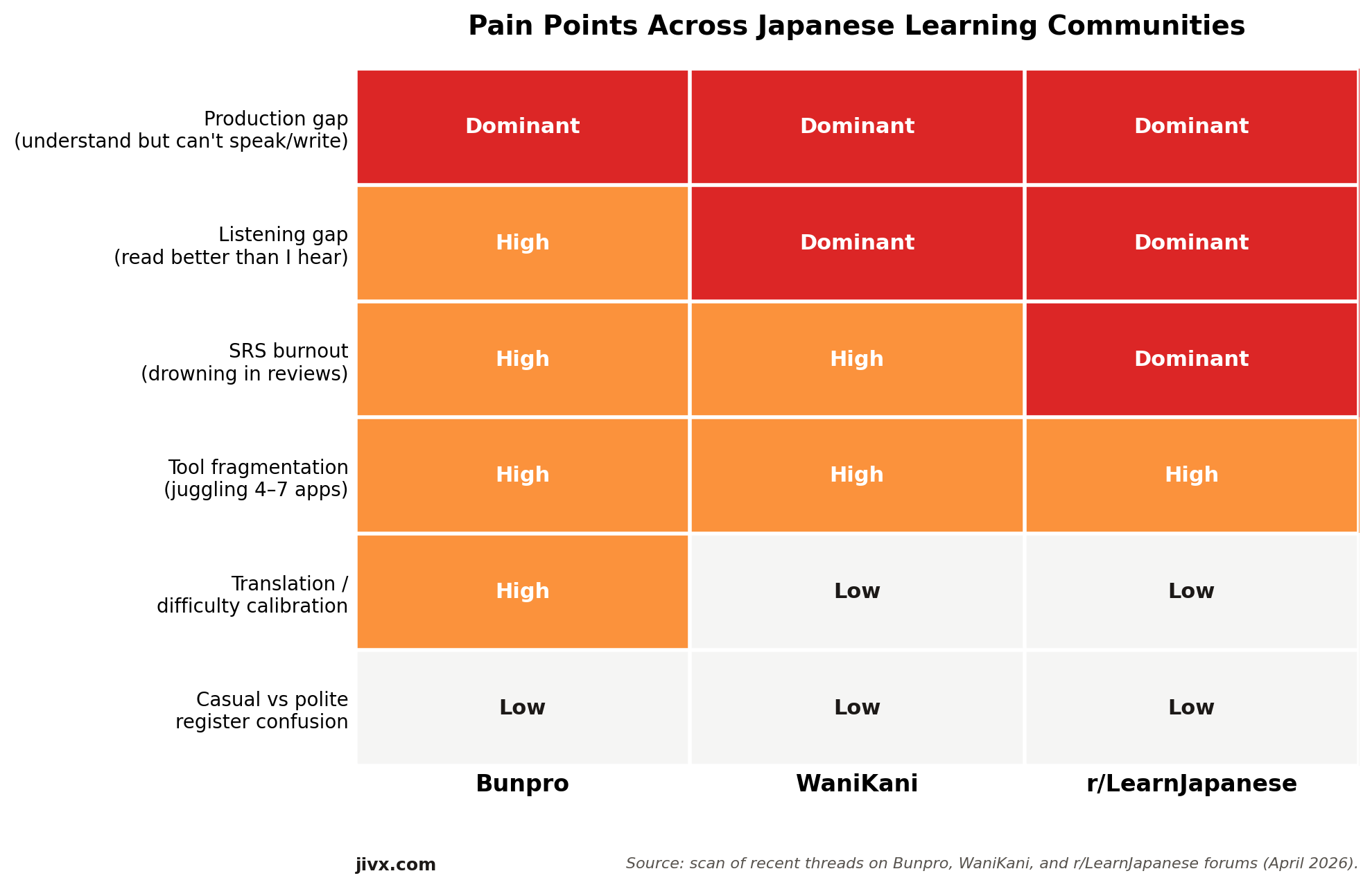
Just to make clear that this is not one cherry-picked thread — here is what the three biggest Japanese learning communities have actually been talking about, based on a scan of recent threads on Bunpro, WaniKani, and r/LearnJapanese:
| Pain point | Bunpro | WaniKani | r/LearnJapanese |
|---|---|---|---|
| Production gap (understand but can't speak/write) | Dominant | Dominant | Dominant |
| Listening gap (read better than I hear) | High | Dominant | Dominant |
| SRS burnout (drowning in reviews) | High | High | Dominant |
| Tool fragmentation (juggling 4–7 apps) | High | High | High |
| Translation/difficulty calibration | High | Low | Low |
| Casual vs polite register confusion | Low | Low | Low |
The same three pain points dominate everywhere: production gap, listening gap, and SRS burnout. They are not coincidence. They are the natural exhaust of recognition-only study. After enough months, the rest of the iceberg becomes visible.
Try the Recall Test Right Now#
Before going further, here is a small, slightly uncomfortable exercise. Read each English prompt below. Type the full Japanese sentence — kana, kanji, particles, conjugation. Then hit Grade. The widget calls the same Claude-powered grader JIVX uses internally and tells you exactly what was right, what was off, and why.
Three sentences. One uncomfortable test.
Powered by JIVXRead the English. Type the full Japanese sentence from memory. One try per sentence — make it count.
Talking about your morning
I eat breakfast every morning.
One attempt per sentence keeps the diagnostic honest. Want unlimited tries across 2,500 sentences? Practice free on JIVX →
If even one felt rough, you've just experienced the gap firsthand. The Japanese was almost there — but "almost there" is exactly the place real conversation breaks down. You've been training the wrong direction.
What Actually Closes the Gap#
The cure is not mysterious. It is just under-practiced because it is the one form of study that exposes you to your own gaps in real time, which is uncomfortable. The four solo techniques below all force retrieval — pick at least two and run them daily. The fifth, real conversation, is what you graduate to once the freeze starts to thaw.
1. Sentence Construction (English → Japanese)#
The most direct fix. Read an English prompt, build the full Japanese sentence yourself before checking. This is the single technique that maps onto what speaking actually requires: starting from a thought and producing Japanese on the way out.
Without a feedback loop, this is hard to do alone — you can write the sentence but you can't be sure your particles are right or your conjugation is natural. AI grading or a tutor closes that loop. Even 10 sentences a day moves the needle in 2–3 weeks.
2. Shadowing#
Find a Japanese audio clip at the high end of your comprehension level. Play it. While it plays, repeat each phrase out loud, on top of the audio, with maybe a half-second delay. You are not translating. You are mimicking — sound, rhythm, pitch.
Shadowing trains a different skill called automaticity — the speed at which your mouth can keep up with a Japanese-shaped thought. In the same Bunpro thread quoted at the top of this article, RiftGazing flagged the underlying issue as "the speed at which I put together sentences," and a fellow learner replied with the textbook diagnosis: "this is called automaticity and shadowing helps a lot with this!" That short exchange is the entire prescription.
If you want a step-by-step breakdown, search YouTube for "Japanese shadowing technique" — there are excellent free walkthroughs from native-speaker teachers. The technique itself is what matters; the source can be anyone with clear audio.
3. Self-Narration#
Throughout the day, narrate what you're doing in your head — in Japanese. Aim for the simplest version that maps onto the moment:
- "I'm making coffee." → コーヒーを作っています。
- "It's hot today." → 今日は暑いです。
- "I want to read this." → これを読みたい。
Not perfect grammar. Not full sentences when you're tired. Just attempted retrieval, all day long.
Self-narration is what beats the freeze. The freeze is your brain hesitating because it has never done this before. By the time you've narrated 10,000 small things, the path from thought to Japanese is worn in like a footpath through grass.
4. Dictation#
This one trains the listening half of speaking. Find a learner-friendly podcast or audio clip. Play one sentence. Pause. Write down exactly what you heard. Compare to the transcript.
Dictation forces your ear to discriminate sounds your eye has been letting slide. It's the cure for what a WaniKani user described here:
"my listening ability is way behind my reading ability. … So once my brain tries to work out a few words, the audio has continued on to the next sentence and I'm just lost."
— snflwi, WaniKani forum
If you've been there, NHK Easy News (audio + transcripts, free) is a forgiving starting point.
5. Real Conversation (When You're Ready)#
Once the freeze starts thawing, find a language exchange partner on HelloTalk or Tandem, book a cheap iTalki community tutor, or hop into a city language meetup. Real conversation is where everything you've practiced gets stress-tested under live conditions.
You don't have to start here. Most learners find self-practice for 2–4 weeks first makes the first conversation 10× less painful.
Try sentence construction with AI feedback
Build full Japanese sentences from English prompts. JIVX grades each one with Claude and tells you what to fix. Free forever on N5.
Start Practicing FreeThe 8-Week Output Protocol#
If you want a concrete plan, here is a protocol that puts the techniques above into a structured 8-week routine. It assumes you keep your existing study (WaniKani, Bunpro, Anki, whatever) and add output practice on top — not replace it.
Weeks 1–2: Wake up the retrieval pathway.
- 10 sentence constructions per day (English → Japanese, with feedback)
- 5 minutes of shadowing per day
- 1 minute of self-narration, 3× per day (set phone reminders)
Weeks 3–4: Build automaticity.
- 15 sentence constructions per day
- 10 minutes of shadowing per day
- 5 minutes of self-narration in continuous blocks
- Add 1 dictation session per week
Weeks 5–6: Add live pressure.
- Continue all of the above
- Book one 30-minute iTalki community tutor session per week
- Or join a language exchange app and have one written conversation per day
Weeks 7–8: Production becomes default.
- Sentence construction is part of your daily routine, not a chore
- One real conversation per week minimum
- Shadowing is your warm-up before any input session
A printable PDF version of this protocol with daily check-boxes is available here.
The protocol works because every single block forces retrieval. There is no recognition-only filler. Eight weeks is also long enough to see your conversation freeze visibly fade — most learners notice the change around week 3 and the rest of the protocol consolidates it.
Where JIVX Fits (An Honest Pitch)#
Full disclosure: I built JIVX. So this section is biased — but I'm going to try to make it useful anyway by being specific about what JIVX does and what it doesn't.
What JIVX does, in one sentence: turns the closes-the-gap technique above (English → Japanese sentence construction with feedback) into a daily 10–15 minute habit you can stick to.
In a little more detail:
- English prompt → you write the full Japanese sentence. Kana, kanji, particles, conjugation. No multiple choice. No word banks.
- Claude grades each attempt. It tells you what's wrong, what's grammatically fine but unnatural, and what's perfect. You also get sub-scores for grammar, vocabulary, and tone (polite vs casual).
- Audio on every sentence, in both polite and casual registers, female and male voices.
- Voice input via OpenAI Whisper. Speak your answer; the audio is sent to OpenAI's Whisper API, transcribed, and graded like a typed answer. The closest thing to a conversation partner that's available 24/7.
- SM-2 spaced repetition schedules the sentences you struggle with for the right intervals — without burying you in reviews.
- Grammar journal auto-tracks every grammar pattern you've practiced, with accuracy stats per pattern.
- 2,500 sentences across N5 → N1, spanning everyday situations: ordering food, making weekend plans, apologizing to your boss.
In other words: JIVX is the bottom row of the decoder table above — the only one where the right two columns aren't blank. That's by design. Sentence construction with AI feedback is what no other tool in the stack does well, and it's what closes the gap.
At a glance#
| Item | What you get |
|---|---|
| Free tier | Full N5 access, AI grading, voice input, audio, garden gamification — no credit card |
| Paid tier | N4 → N1 unlock, deeper history, friend referrals (+5 daily sentences each) |
| AI model | Claude Haiku 4.5 |
| Voice input | OpenAI Whisper API |
| Audio | Native-style TTS, female + male voices, polite + casual |
| SRS | SM-2 algorithm |
| Levels | N5, N4, N3, N2, N1 |
| Sentence count | ~2,500 |
| Platforms | Web app + PWA (installable on mobile) |
What JIVX does NOT do:
- Not a kanji SRS. Use WaniKani if that's what you need.
- Not a structured grammar curriculum. Bunpro and Tae Kim's guide are still the standards there. (For pattern lookup, the JIVX grammar reference covers 170+ patterns N5 → N1.)
- Not an immersion content library. Satori Reader and graded readers have that covered.
- Not a substitute for live conversation. iTalki and language exchange apps still own that space.
JIVX is built to plug into a stack, not replace one. If your existing tools are working for kanji, grammar, and vocab — keep them. Add output practice. The gap closes.
Related reading#
If you're navigating other facets of the same plateau, these companion posts go deeper on each:
- Why you can read Japanese but can't write a sentence — the writing side of this same gap, with a journaling-focused protocol.
- Japanese listening practice for people who can read but can't hear — the listening half of speaking, with dictation drills.
- How to overcome SRS burnout in Japanese study — when the review pile is winning.
- Casual vs polite Japanese: when to switch register — for the moments your speech is technically right but socially off.
- How to practice speaking Japanese alone — solo techniques, no partner required.
What This Looks Like in 90 Days#
Most readers won't believe this until they try it, but here's what tends to happen if you actually run the 8-week protocol and keep going for one more month:
- Week 3: the conversation freeze starts to soften. You can produce a full sentence in 3–5 seconds instead of 10–15. You also notice you're less afraid of being asked questions.
- Week 6: simple Japanese conversation feels like Japanese, not like translation. The pause before each sentence is shorter. You start enjoying the practice.
- Week 12: you can have a basic conversation about your day, your plans, your opinions on food, weather, hobbies — without your brain switching to English mode in the middle.
You will not be fluent. You will not be N1-tested. But you will have closed the most painful gap in Japanese learning — the one where you understand everything but produce nothing — and the rest of your study time will start feeling like it's adding up to something.
Stop reviewing. Start producing.
JIVX gives you English prompts and grades your Japanese with Claude. The fastest way to close the comprehension–production gap.
Try JIVX FreeFrequently Asked Questions#
Why can I understand Japanese but not speak it?
What is the comprehension-production gap?
Why do I freeze up when trying to speak Japanese?
How do I practice speaking Japanese without a partner?
How long until I can hold a Japanese conversation?
Forum Threads Referenced#
If you want to read the full discussions that inform this article, these are the public forum threads worth your time:
- I understand, but I still can't speak — Bunpro forum, April 2026
- Is bunpro really worth it? — Bunpro forum, April 2026
- I can't 'see' Kanji while listening — WaniKani forum, March 2026
- Tips on listening and speaking — WaniKani forum, April 2026
- What's your 2026 Japanese Learning Resolution — r/LearnJapanese, December 2025
The pattern is clear and the pattern is consistent: comprehension is not the bottleneck for most intermediate learners. Production is. Closing the gap is not glamorous work — it is small, daily, slightly uncomfortable retrieval practice — but it is also the work that turns "I know hundreds of words" into "I just had a Japanese conversation."
Start today. Ten sentences. The gap doesn't close itself.
Ten sentences. Five minutes.
Open JIVX, pick an English prompt, write the Japanese, get AI feedback. Repeat. Free forever on N5 — no credit card.
Start Closing the Gap